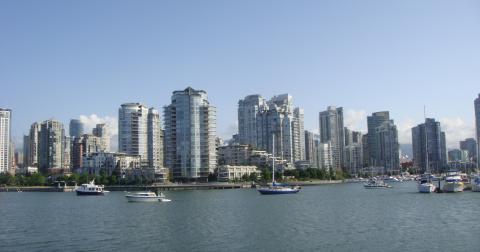
Introducing my 2012 New York Travelblogue... Dining and Theatre in my second favorite city...after Vancouver of course.
I usually choose to travel to New York in the fall or the spring, occasionally the summer. When leaving Vancouver in the winter, my choice of winter destinations would involve warmth, sunshine , beaches or ... a dance cruise. But this year a family event drew me to Manhattan in January, and here I am in a city that today, despite the sunshine, is drier but far colder than home .
I am not a rabble rouser. I don't sign petitions or march in parades to support or protest against ideologies or political actions. I don't subscribe to any particular socio-political ideals but make up my mind based on how I see the reality of a specific situation. So why did I, along with a whole lot of people, head off to hear a reading of Homegrown by Catherine Frid, on the same night in eleven different locations across Canada?
It's simply because I think that the arts are vital in creating an intelligent, thoughtful, curious society, and new works will not be created and performed if financial support for the arts is not there. SummerWorks is a Festival of new works or experimental productions by young companies, that has been held in Toronto since 1991. Originally a Fringe-style format, it evolved into a juried festival, where a panel of theatre professionals evaluate the proposals and select the plays to be performed.
For those of you who been asking whether I have stopped "Sipping and Supping" or enthusiastically checking out the Vancouver "Theatre Seen", and those others who have asked why my saga of the Autumn East Coast Dance Cruise seemed to drop anchor temporarily in Bar Harbor, Maine - here is the explanation and a cautionary tale.
On my return from a blissful 10 night cruise, dancing from Brooklyn to Quebec and back, followed by yet more dancing - New York, New York Autumn 2010 I returned home to Vancouver to catch up on my travel writing. Feeling as fit as I have ever been, if I had been eligible (like under 30!) I was ready to give the kids on So You Think You Can Dance some strong competition. Well, maybe a slight exaggeration.
Autumn in New York - Eight days and nights in the city that never sleeps
Sunday
I love New York - just like it says on the T-shirts they hawk everywhere around Times Square. Well perhaps I should qualify that statement by saying that I love spending a week or so in New York in the early fall, seeing theatre, trying out fine restaurants and dancing. Last year I was here at approximately the same time (New York New York ) and saw some outstanding shows including A Steady Rain with Hugh Jackman and Daniel Craig, and Burn the Floor, which so blew me away that I saw it again, and then again for the show at the Vogue in Vancouver.
I can hardly wait till June 30th to find out what is in my Ticketpalooza! "mystery" ticket package. What on earth is Ticketpalooza, you may ask?
Ticketpalooza, organized by the Greater Vancouver Professional Theatre Alliance aims to raise the visibility of the work of Lower Mainland theatre companies, large and small, through an online fundraiser selling tickets to a variety of shows.
There are 40 "mystery" ticket packages, donated by over 45 theatre companies are NOW AVAILABLE for you to purchase at price points of $50 and $200, with values of at least these amounts. All packages include tickets to GVPTA member company theatre productions, and many also include dinner or drinks at a local area restaurants. $200 packages may also include additional theatre tickets, entrée to other cultural events, and/or hotel stays at some of the best hotels in town!
Beyond Eden by Bruce Ruddell
Music by Bruce Ruddell and Bill Henderson
Directed by Dennis Garnhum
Music Direction by Bill Henderson
Choreographer Jacques Lemay
Fight Director JeanPierre Fournier
Co-produced by Vancouver Playhouse and Theatre Calgary
Jan 16 to Feb 6 th, 2010
Photographs by David Cooper
Vancouver, BC: Just imagine. You dream an "impossible dream" for 25 years and finally one exhilarating night, your dream explodes into reality in a visually and musically stunning production. Beyond Eden had its world premiere last week on the Vancouver Playhouse stage as part of the Vancouver 2010 Cultural Olympiad and it is a "tour de force". Bruce Ruddell and his creative collaborators, cast and crew can truly be proud of how his dream has been actualized.
Nelly Boy by Dave Deveau Directed by Cameron Mackenzie Zee Zee Theatre and Screaming Weenie Productions PAL Theatre Oct 22- Nov 1, 2009
Vancouver, BC: For 75 minutes you could have heard a pin drop in the small space of the PAL theatre. As the actors exited and the lights went to black, the words "brave, terrifying, sad" competed in my head with "so that's the real Allan Zinyk". I think this is the first time I have seen him playing a normal person in a straight as opposed to a comedic role, and it brought to mind a handsome Allan Rickman - as Steven Spurrier (Bottle Shock) not the infamous Snape, of course.
But I digress. Zinyk plays the Man/ Father of Nelly/Nelson (Amitai Marmorstein) a fragile young teenager who is struggling to come to terms with gender identity. As Man (not a social worker, a cop, a teacher, a lawyer- therapist maybe?), who is simply there to get Nelly to tell his story, Zinyk conveys flashes of compassion, mixed with irritation and impatience, with sudden switches of character to become Dad.
Via Beatrice Written by Jenn Griffin Composed and musically directed by Peggy Lee Directed by Matthew Bisset Fugue Theatre Playwrights Theatre Centre, Granville Island 13th - 22nd August, 2009
Vancouver, BC: Almost exactly a year ago I watched a staged reading of an early version of Via Beatrice at the Playwrights Theatre Centre. At the time I commented on my Works in Progress page commentary that " It is always a privilege to get a peek into the creation of a new work, and then, hopefully, to see a full production of the finished version." And it really was exciting to see the polished production that this work has become in a year.
The Creators: One-on-one with Emil Sher, author of Mourning Dove and Hana's Suitcase
Among the many excellent productions in Vancouver in 2008, Pacific Theatre’s staging of Emil Sher’s Mourning Dove touched my heart and mind most deeply. I loved the play and the restrained sensitivity with which the writer addressed the unfolding of a tragedy that no parent should ever have to experience. When I realized that Sher was also the author of Hana’s Suitcase, another very moving play that I had recently read, I was compelled to read more of his work. These experiences raised a whole lot of questions that I wanted to pose to the playwright. To my delight, Emil Sher generously agreed to be interviewed for “Creators and Communicators,” the section of Theatre Seen that highlights the creative artists that “make theatre.”
One-on-one with Emil Sher
Emil, I note that your undergraduate degree from McGill was in English and that you taught English in Botswana before returning to do an MFA in Creative Writing at Concordia. Was it your experiences in Botswana that stimulated your desire to write or were you compelled to write from childhood?
Initially, I had contemplated becoming an actor, and focused on theatre as an undergraduate at McGill. But during my time there I became increasingly drawn to the written word, and wrote a fair bit for the McGill Daily, the school newspaper. And as much as I enjoyed journalism (I still find creative non-fiction very gratifying), there is something about the latitude of fiction that always appealed (and I use the word ‘fiction’ loosely to include work for stage and screen). I went to Botswana naively believing I would have time to write, though I wasn’t quite sure what I was going to write about (never a good start for a writer). I soon discovered that teaching is a craft like any other, and required substantial amount of time, energy and care if I was going to do it right. I knew the only way I would be able to write meaningfully was to immerse myself in an environment where I would have to write on a regular basis, and graduate school was the ideal opportunity to do just that. I focused on fiction (my thesis was a collection of short stories) and made a decision upon graduating that I would write in different genres, as the spirit moved me and as opportunities surfaced.
You have written plays for both radio and stage. Could you comment on how your approach differs between writing for radio - theatre of the mind - versus a play that is intended to be physically staged?
Every genre of writing comes with its own toolbox, and I’m still learning how to take advantage of the tools at my disposal. Indeed, I’ve come to see the writing life as a lifelong apprenticeship. What I love about radio is how the narrative is distilled to sound, or silence: a voice, a sound effect, or a moment when nothing is said, when nothing is heard, and yet it is a moment that speaks volumes. Radio has been called “theatre of the mind” for good reason, and it insists that the audience actively engage with the story. Engaging an audience or a reader is essential to how I write, regardless of the genre or the audience I am writing for (which is sometimes as young as pre-schoolers). It is this objective that dictates my approach to radio dramas and stage plays. With radio, I’m more conscious of how dialogue is the foundation upon which the story rests. There is nothing else to create the world of a radio play but for sound, human or otherwise. And so the challenge is to make sure each word and sound can be justified. The intimacy of the medium demands it. With a stage play, I feel the text is but one part of a larger narrative. The set, the lighting design, the very presence of an actor significantly alters our interpretation of the story being told. When I write a play I’m mindful of the varied elements that will ultimately shape it, and am inspired by the collective energies that fuel a stage work. And while it takes a team effort to create a radio play, the process feels more contained, compared to the open-ended development of a stage play, which is often defined – and enriched – by the detours that surface during roundtable, workshop discussions about the text, generating questions that challenge me to justify my creative choices, revisit them, or reject them.
Have you ever directed any of your own plays?
I’ve yet to direct one of my own plays, and feel more drawn to directing a film. I’m especially drawn to the editing process. I said as much to a talk I once gave to a group of theatre students, and one student remarked that editing is not unlike writing, in that it speaks to the importance of structure. It’s often said that writing is rewriting, and that’s not dissimilar to sitting in an editing suite, rearranging a narrative so that it’s a structurally sound as it can be.
As a working contemporary Canadian playwright do you always present a completed script or do you ever work with a director as a dramaturge to massage and shape the script on its feet?
When it comes to a new play, I offer directors a completed script insofar as it’s a draft we can build upon. Initially, the conversation is between myself and the director, who may or may not double as a dramaturge. In some instances, the three of us – playwright, director, dramaturge – have discussed a script in its formative stages. That process is further enriched through workshops, where the script is given a reading by actors who may have their own insights to offer. I see this process as very fluid: changes are made to the script that usually stem from questions posed by the director, an actor, or myself. Scenes are dropped, or rearranged or cut. It takes several drafts before I’m satisfied, and often there’s a substantial rewrite somewhere along the way. My guiding principle when developing a script with collective input can be distilled to a simple question: “Does it serve the story?” Not an actor’s ego or a director’s agenda, but the story.
Or from another perspective: When you hand over your work to a director do your scripts feel complete? Or do you find that as you watch them unfold, there are changes you want to make or other stories that grow out of what you see on stage?
Is a script ever complete, or completely finished? There comes a time when the creative process has run its course and it’s time to let go. There’s always the liability that a script can take too long to gestate, that it can be overwritten and overworkshopped. That said, I have made script changes from one production to the next for all my plays. There is always a word or a phrase that can be tweaked or parsed, and I find this aspect of playwriting very gratifying: the script isn’t static. It can become stronger with each successive staging, and thus become a different play each time.
Last night I made my way gingerly along a dusty, construction-damaged Granville Street, to the Commodore Ballroom where Vancouver's theatre community gathered to celebrate another year of amazing theatre. It is always interesting to see how the nominations and the final award winners stack up against what I thought during the year of play-going, and what details I can remember of the many productions. As well, the productions nominated are only a portion of the many shows staged here - Vancouver has a great theatre scene, and often I find that there are more things available to see than hours to see them in. Any way here is the list of finalists with links to those plays I managed to review during the year and featured pictures. Congratulations to all the nominees, and of course to the Jessie winners
Jessie Richardson Awards Large Theatre 2008-2009
Outstanding Performance by an Actor in a Lead Role
Jay Brazeau, The Drowsy Chaperone, Playhouse Theatre Company
Outstanding Performance by an Actress in a Lead Role
Jennifer Lines, The Tempest, Bard on the Beach
Outstanding Performance by an Actor in a Supporting Role
Simon Bradbury, Titus Andronicus, Bard on the Beach
Outstanding Performance by an Actress in a Supporting Role
Margo Kane, Where the Blood Mixes, Playhouse Theatre Company & The Savage Society
Significant Artistic Achievement
Alan Brodie, Patrick Clark, Jamie Nesbitt,
Exceptional Integration of Visual Design, Frost/Nixon, Playhouse Theatre Company
Recent comments