play

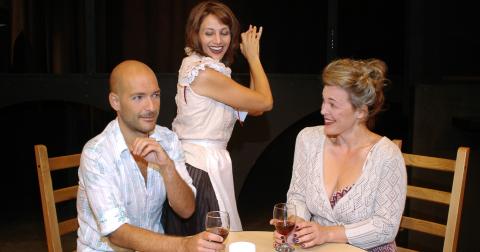
Todd Talbot and Lauren Bowler. Photo credit TUTSAnything Goes
Music and lyrics by Cole Porter
Original book by PG Wodehouse, Guy Bolton, Russell Crouse, Howard Lindsay
New book by Timothy Crouse and John Weidman
Director Sarah Rodgers
Music Director Christopher King; Choreographer Dayna Tekatch
Theatre Under the Stars,
Malkin Bowl, Stanley Park
Alternating nights July 13 to August 20th, 2011

Vancouver, BC: As we sat at a window table enjoying an exceptionally good pre-show meal at the new Ensemble restaurant, we watched raindrops spattering on the pavement. It looked like the weather forecasts were  correct and the opening night of Anything Goes would take place under wet skies.

Seth Little and Andrew Cownden. Photo credit TUTSBy the time we walked into Malkin Bowl to find our seats the sky had temporarily cleared but before the show began the drizzle started up again and the TUTS volunteers were handing out transparent ponchos to keep everyone in the audience dry.

But not even the rain could decrease my appreciation of Cole Porter's marvelous musical. Anything Goes is one of my favorites because almost every tune is a "stick in the head" kind of melody.  My IPod ballroom dance music collection has quickstep versions of "It's De-Lovely", "You're the Top" and "I Get a Kick out of You", and I think I  have most of Porter's clever lyrics permanently implanted in my brain. So I sang along silently in my head, and enjoyed the show a whole lot.

Cast members of Bye Bye Birdie. Photo credit TUTS.Bye Bye Birdie
Book by Michael Stewart; Music by Charles Strouse; Lyrics by Lee Adams
Director Shel Piercy
Music Director Kevin Michael Cripps; Choreographer Shelley Stewart-Hunt
Theatre Under the Stars,
Malkin Bowl, Stanley Park
Alternating nights July 12 to August 20th, 2010

Vancouver, BC: It is summertime in Vancouver - sort of - and Theatre Under The Stars is back for its 65th season.  After an early meal at Le Bistro de Paris, we were looking forward to the opening night of Bye Bye Birdie, which runs alternate evenings with one of my favorite musicals, Anything Goes, which is packed with songs  by the fabulous Cole Porter.

Lalainia Lindbjerg as Rosie. Photo credit TUTSIt's easy to see why Bye Bye Birdie is a favorite musical for high school and college shows. Inspired by the 1958 drafting of Elvis Presley into the US army,  the storyline centers around rock and roll idol Conrad Birdie (Erik Gow), who is about to go overseas to serve his time in the army. His agent Albert (Daniel White) worries that this is the end of his business. His girlfriend / secretary Rosie  (Lalainia Lindbjerg) who wants Albert to give up the music business, marry her and became an English teacher, has an idea for one last publicity stunt to make them rich. Conrad will record Albert's new song, One Last Kiss, and one lucky teenage fan, Kim (Amy Jean Mcelwain) from small-town Sweet Apple, Ohio, will be kissed by Conrad on the Ed Sullivan show. Of course nothing works out as planned but everything turns out happily in the end. 

 Marco Soriano, Laura  Di Cicco and Lucia Frangione in Via Beatrice. Via Beatrice
Written by Jenn Griffin
Composed and musically directed by Peggy Lee
Directed by  Matthew Bisset
Fugue Theatre
Playwrights Theatre Centre, Granville Island
13th - 22nd August, 2009

Vancouver, BC:  Almost exactly a year ago  I watched a staged reading of an early version of Via Beatrice at the Playwrights Theatre Centre. At the time I commented on my Works in Progress page commentary that  " It is always a privilege to get a peek into the creation of a new work, and then, hopefully, to see a full production of the finished version." And it really was exciting to see the polished production that this work has become in a year.

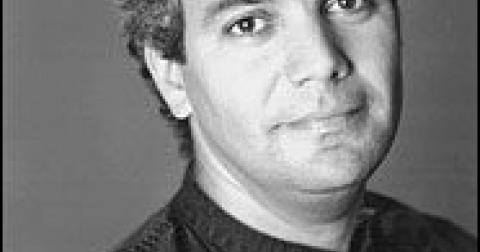
The Creators: One-on-one with Emil Sher, author of Mourning Dove and Hana's Suitcase Emil Sher

Among the many excellent productions in Vancouver in 2008, Pacific Theatre’s staging of Emil Sher’s Mourning Dove touched my heart and mind most deeply. I loved the play and the restrained sensitivity with which the writer addressed the unfolding of a tragedy that no parent should ever have to experience. When I realized that Sher was also the author of Hana’s Suitcase, another very moving play that I had recently read, I was compelled to read more of his work. These experiences raised a whole lot of questions that I wanted to pose to the playwright. To my delight, Emil Sher generously agreed to be interviewed for “Creators and Communicators,” the section of  Theatre Seen that highlights the creative artists that “make theatre.”

One-on-one with Emil Sher

Emil, I note that your undergraduate degree from McGill was in English and that you taught English in Botswana before returning to do an MFA in Creative Writing at Concordia. Was it your experiences in Botswana that stimulated your desire to write or were you compelled to write from childhood?

Initially, I had contemplated becoming an actor, and focused on theatre as an undergraduate at McGill. But during my time there I became increasingly drawn to the written word, and wrote a fair bit for the McGill Daily, the school newspaper. And as much as I enjoyed journalism (I still find creative non-fiction very gratifying), there is something about the latitude of fiction that always appealed (and I use the word ‘fiction’ loosely to include work for stage and screen). I went to Botswana naively believing I would have time to write, though I wasn’t quite sure what I was going to write about (never a good start for a writer). I soon discovered that teaching is a craft like any other, and required substantial amount of time, energy and care if I was going to do it right. I knew the only way I would be able to write meaningfully was to immerse myself in an environment where I would have to write on a regular basis, and graduate school was the ideal opportunity to do just that. I focused on fiction (my thesis was a collection of short stories) and made a decision upon graduating that I would write in different genres, as the spirit moved me and as opportunities surfaced.

You have written plays for both radio and stage. Could you comment on how your approach differs between writing for radio - theatre of the mind - versus a play that is intended to be physically staged?

Every genre of writing comes with its own toolbox, and I’m still learning how to take advantage of the tools at my disposal. Indeed, I’ve come to see the writing life as a lifelong apprenticeship. What I love about radio is how the narrative is distilled to sound, or silence: a voice, a sound effect, or a moment when nothing is said, when nothing is heard, and yet it is a moment that speaks volumes. Radio has been called “theatre of the mind” for good reason, and it insists that the audience actively engage with the story. Engaging an audience or a reader is essential to how I write, regardless of the genre or the audience I am writing for (which is sometimes as young as pre-schoolers). It is this objective that dictates my approach to radio dramas and stage plays. With radio, I’m more conscious of how dialogue is the foundation upon which the story rests. There is nothing else to create the world of a radio play but for sound, human or otherwise. And so the challenge is to make sure each word and sound can be justified. The intimacy of the medium demands it. With a stage play, I feel the text is but one part of a larger narrative. The set, the lighting design, the very presence of an actor significantly alters our interpretation of the story being told. When I write a play I’m mindful of the varied elements that will ultimately shape it, and am inspired by the collective energies that fuel a stage work. And while it takes a team effort to create a radio play, the process feels more contained, compared to the open-ended development of a stage play, which is often defined – and enriched – by the detours that surface during roundtable, workshop discussions about the text, generating questions that challenge me to justify my creative choices, revisit them, or reject them.

Have you ever directed any of your own plays?

I’ve yet to direct one of my own plays, and feel more drawn to directing a film. I’m especially drawn to the editing process. I said as much to a talk I once gave to a group of theatre students, and one student remarked that editing is not unlike writing, in that it speaks to the importance of structure. It’s often said that writing is rewriting, and that’s not dissimilar to sitting in an editing suite, rearranging a narrative so that it’s a structurally sound as it can be.

As a working contemporary Canadian playwright do you always present a completed script or do you ever work with a director as a dramaturge to massage and shape the script on its feet?

When it comes to a new play, I offer directors a completed script insofar as it’s a draft we can build upon. Initially, the conversation is between myself and the director, who may or may not double as a dramaturge. In some instances, the three of us – playwright, director, dramaturge – have discussed a script in its formative stages. That process is further enriched through workshops, where the script is given a reading by actors who may have their own insights to offer. I see this process as very fluid: changes are made to the script that usually stem from questions posed by the director, an actor, or myself. Scenes are dropped, or rearranged or cut. It takes several drafts before I’m satisfied, and often there’s a substantial rewrite somewhere along the way. My guiding principle when developing a script with collective input can be distilled to a simple question: “Does it serve the story?” Not an actor’s ego or a director’s agenda, but the story.

Or from another perspective: When you hand over your work to a director do your scripts feel complete? Or do you find that as you watch them unfold, there are changes you want to make or other stories that grow out of what you see on stage?

Is a script ever complete, or completely finished? There comes a time when the creative process has run its course and it’s time to let go. There’s always the liability that a script can take too long to gestate, that it can be overwritten and overworkshopped. That said, I have made script changes from one production to the next for all my plays. There is always a word or a phrase that can be tweaked or parsed, and I find this aspect of playwriting very gratifying: the script isn’t static. It can become stronger with each successive staging, and thus become a different play each time.

True Story
Written and directed by John Murphy
Vancity Culture Lab at the Cultch
5-17 May 2009

Sebastian Kroon and Kayla Deorksen in True StoryVancouver, BC: It's a beautiful sunny day in Vancouver. Since I arrived home yesterday from my Dancing at Sea Cruise (three hours of dance each night and an average of 5 hours sleep) I have barely had time to unpack. I have 6 days of travel writing to finish and a busy evening ahead. But before I left two weeks ago I had committed to attending the 2 pm performance of this show so I hopped in my little car and cruised over the Georgia Viaduct to The Vancity Culture Lab at Venables and Victoria Drive. And I am glad I did.

I found Murphy's play wickedly clever and entertaining. The story - you have to tell a story, right? - ostensibly revolves around a mother whose 4 year old daughter disappeared twenty years ago, and who still clings desperately to the hope that she is still alive somewhere. At least that's how the play is advertised. But it is not as simple as that.

On Mother's Day two years ago, my daughter and I shared something special; the privilege of hearing twenty brave and talented actors share with us the facts of their mothers' lives -  My Mother's Story: A Mother's Perspective . Together we laughed, we cried, and we thought of my mother, Amanda's grandmother, and the part she played in our lives. As we drove home we discussed the empowering effect that relating the arcs of their mothers' lives seemed to have on these women, and that we both felt enriched by the experience of seeing this work.

This Mothers' Day, Sunday May 10th, My Mother's Story 2009 will run at The Granville Isand Stage at 4 pm. In 90 minutes, you will hear about the "extraordinary lives of 20 ordinary women". This year will be the fourth staging of this event by Jenn Griffin and Marilyn Norry.  While some of the women that will perform have been part of previous events, others will be new.  Even if you have seen previous shows, each script is different as  playwright Jenn Griffin interweaves  20 life stories into a story that reaches out from countries as diverse as India, South Africa, Vietnam and England, and evokes memories of love, abandonment, hope and despair. It is impossible to hear the words without something resonating within your own heart.  You can buy tickets through VancouverTix.com . They are $23 dollars, reserved seating - and going fast.

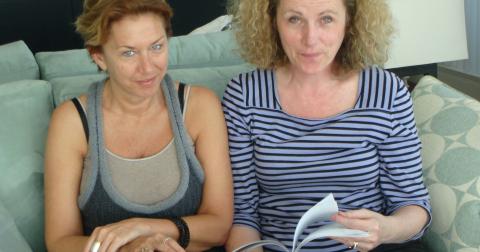
Jenn and Marilyn enjoy a moment of amusement over the scriptJenn and Marilyn share a moment of amusement over the script  As often happens, the end-result you will see on stage, represents the synergy of two talented women bringing together their individual concepts to make something that is more powerful than the sum of the individual ideas. Both Jenn and Marilyn set out to write the story of their mother but the impetus was different for each of them. Although I remembered a bit about the origins of this event from a brief chat after the first show I saw, and I learned more from My Mothers Story  web site,  I wanted to dig a bit deeper and so I invited Marilyn  and Jenn over  for a casual chat.

Follow Me

Sign Up For E-Mail Updates

Enter your email address:

Delivered by FeedBurner

Recent comments